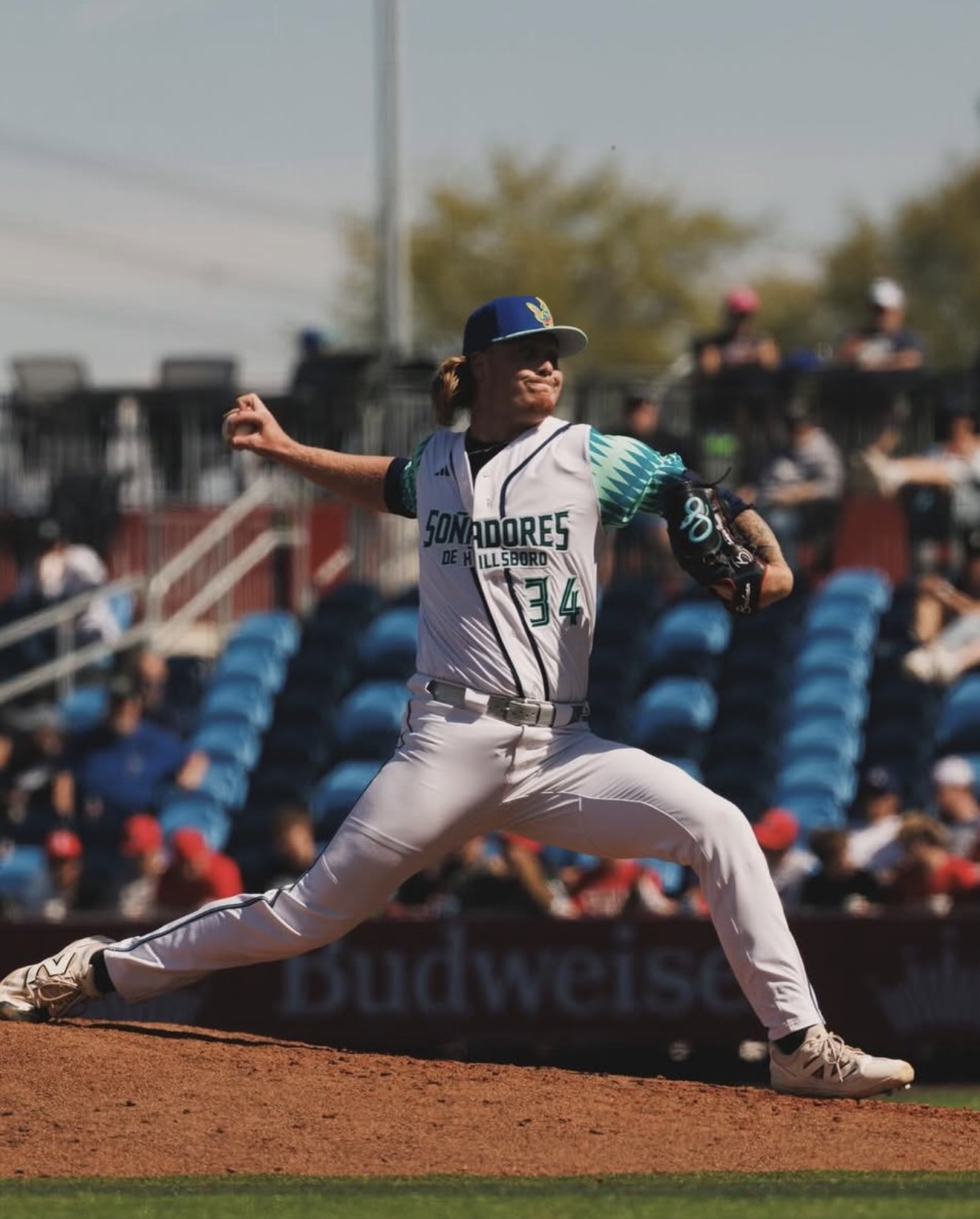
Multi-angle video, athlete history, and mobility screening combine into a structured assessment — then a development plan built from what we actually find, delivered day by day in the Apex Motion app.
Four things hold true whether you're a 14-year-old starting out or a pro in season.
Our analysis framework is evaluated against withheld 3D motion-capture findings — assessment outputs are produced before the comparison data is revealed.
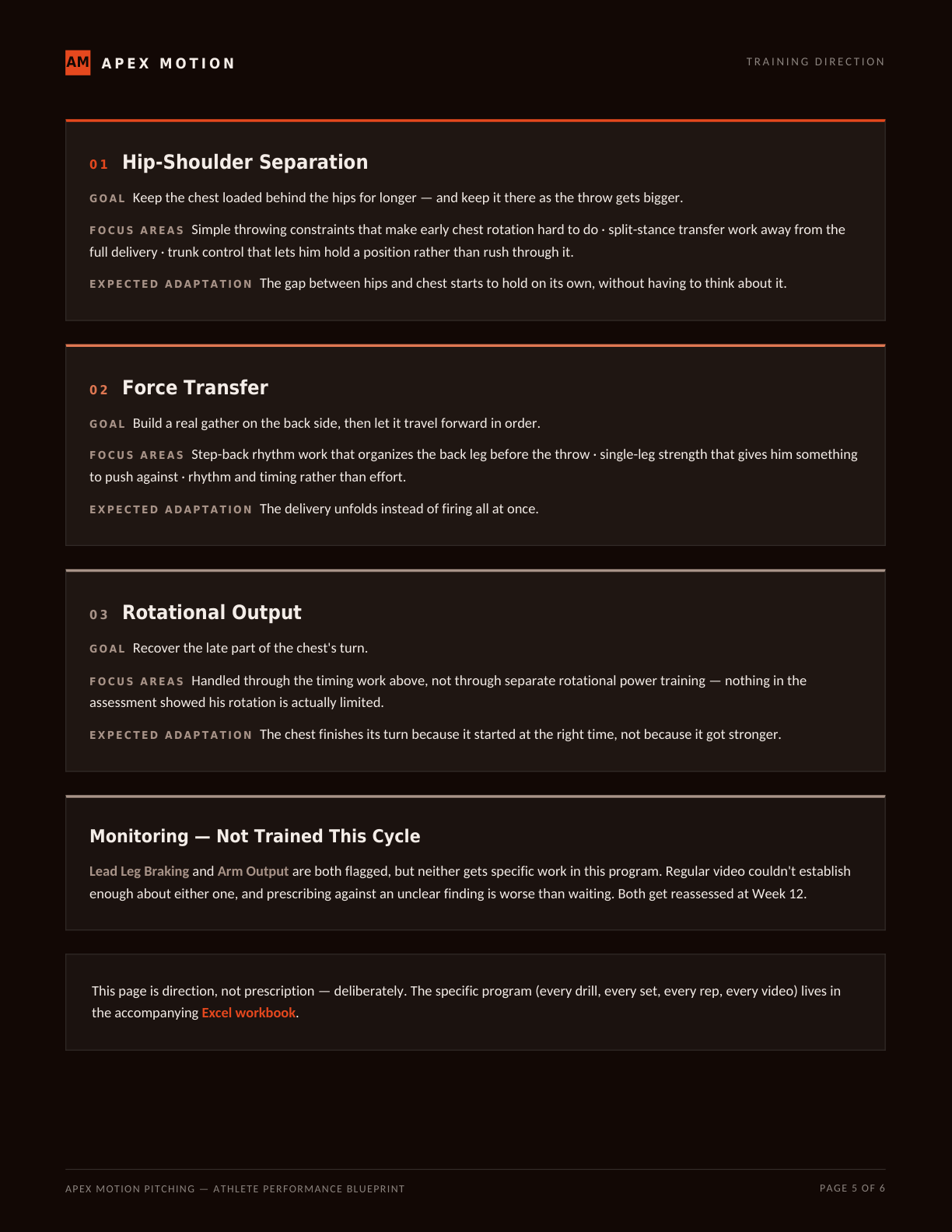
Every athlete is evaluated through the same eight development categories, with explicit confidence and evidence limits — not a different story invented for every delivery.
Supported development needs are connected to a structured intervention library and individualized programming — so what we find is what you train.
Off-season, in-season, or post-season — the plan accounts for your schedule, training history, equipment access, and current workload.
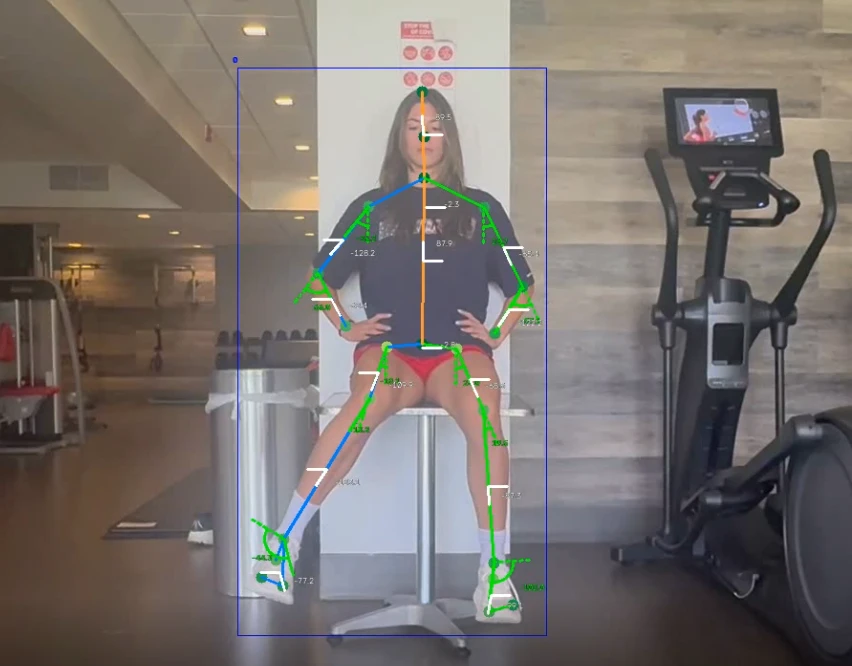
Complete your intake and upload your required multi-angle pitching and mobility videos. Training background, throwing status, goals, equipment, and any restrictions give the analysis context.
Your delivery is evaluated through Apex Motion's 8-category framework, alongside a structured mobility screen. Findings are reported in plain language with confidence and evidence limits — not unsupported measurements presented as fact.
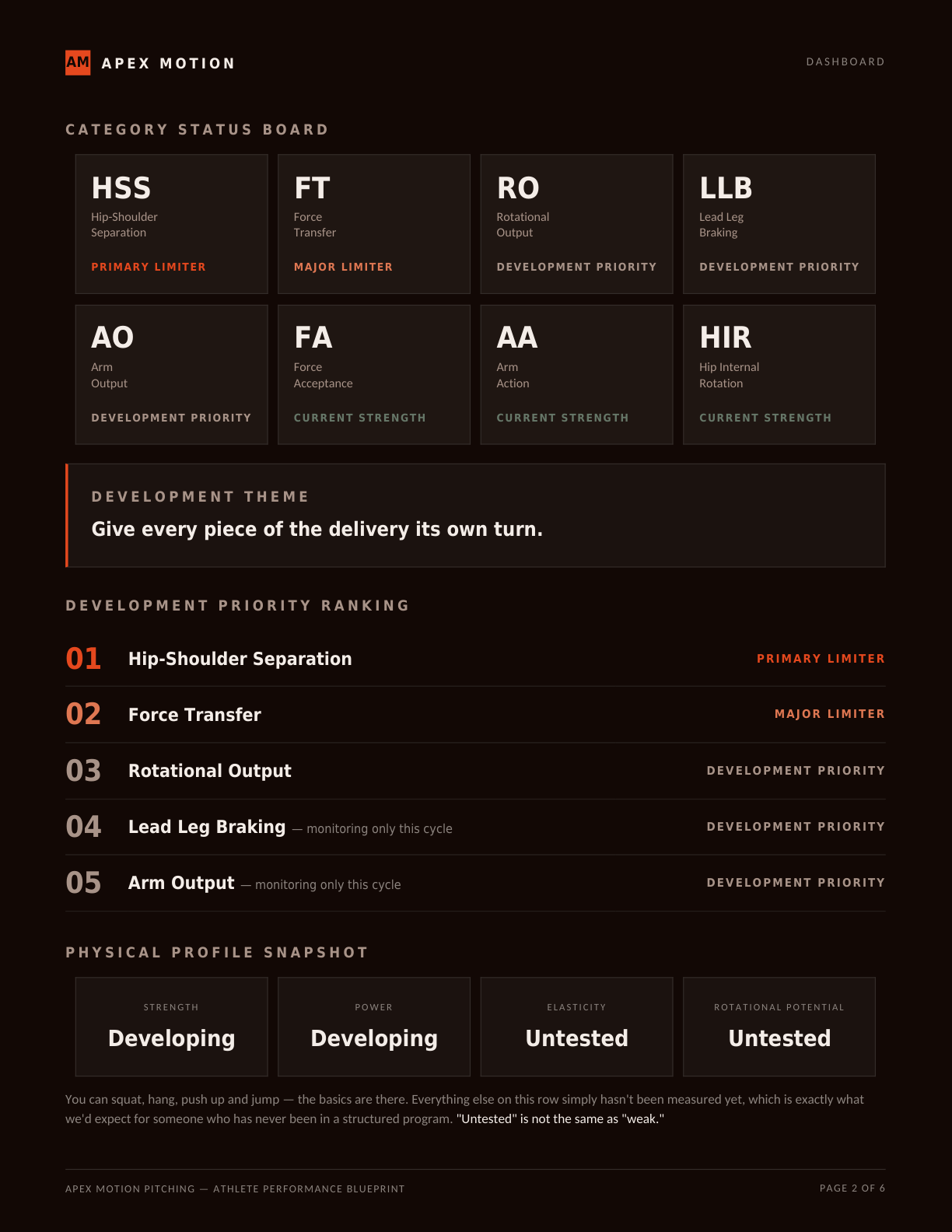
Your Athlete Performance Blueprint explains what was found, how confident we are in each finding, and which development priorities matter most — ranked, in plain language, not buried in a wall of numbers.
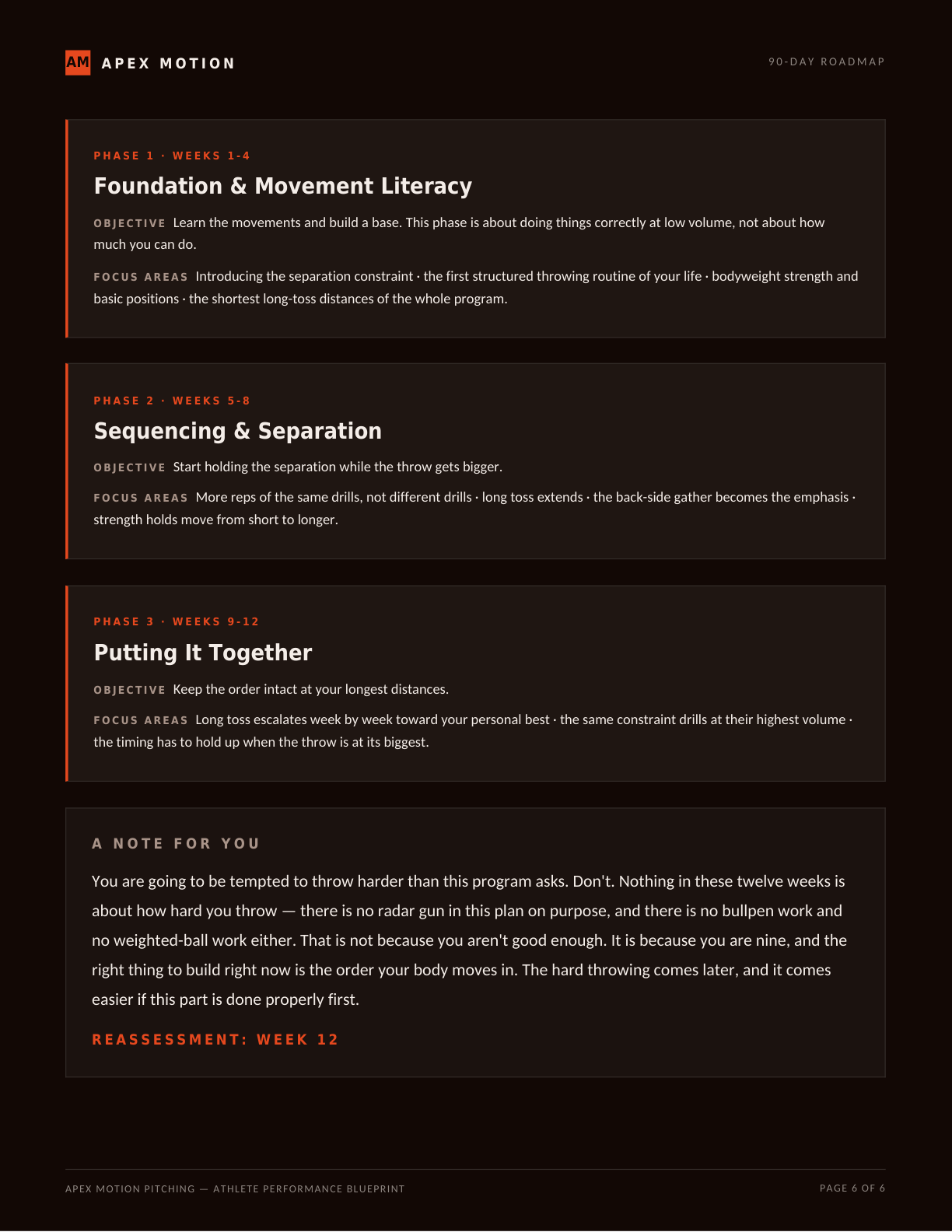
Supported findings and athlete constraints run through Apex Motion's structured intervention system, then land in the Apex Motion app — phase-based throwing and strength, mobility, corrective work, and arm care, laid out day by day.
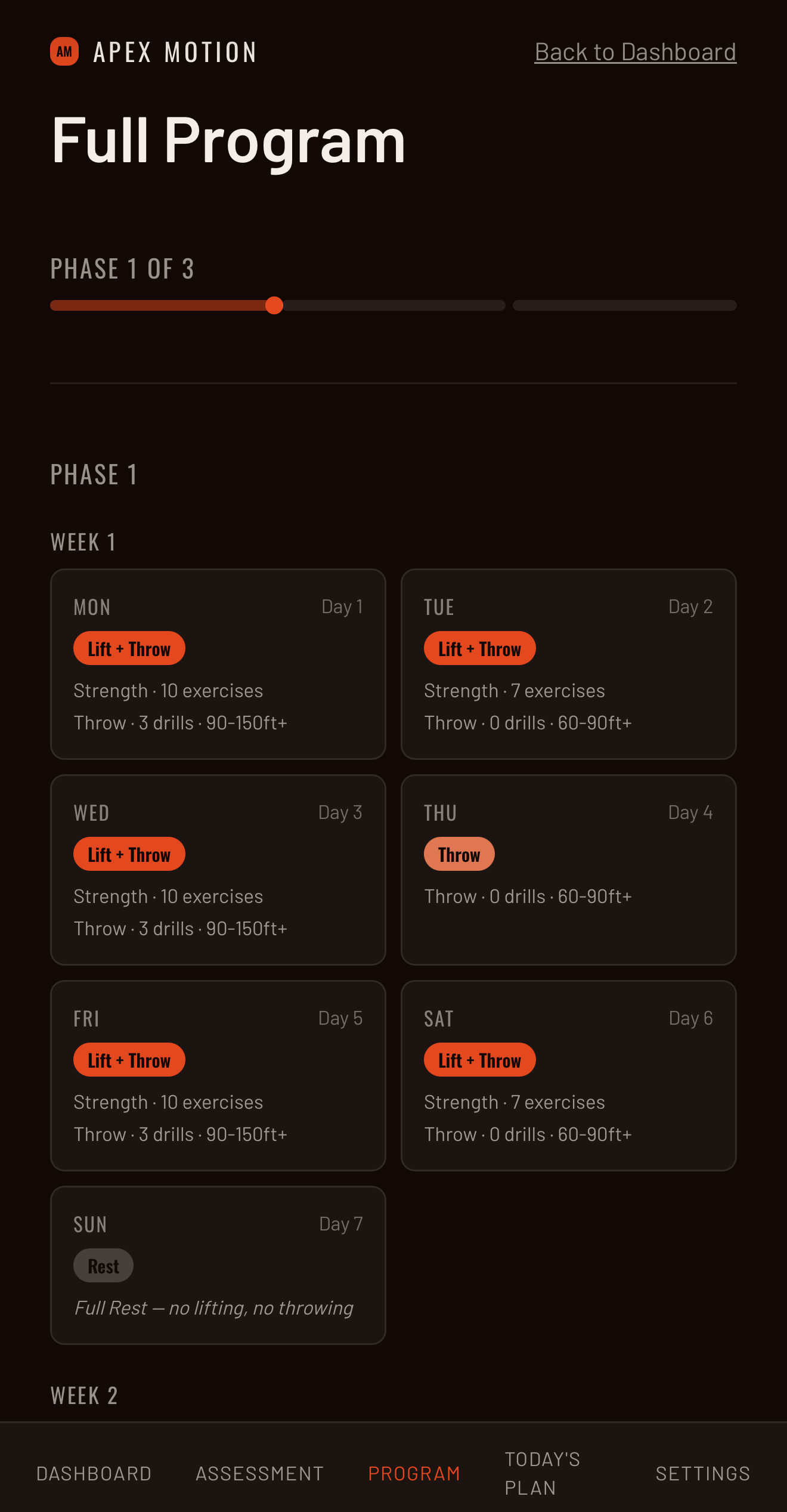
The assessment tells you what's limiting you. The app is where you train from it — every phase, every week, every session, with each exercise tied back to a finding from your own assessment. Drills and lifts come with video demos linked right in the app.
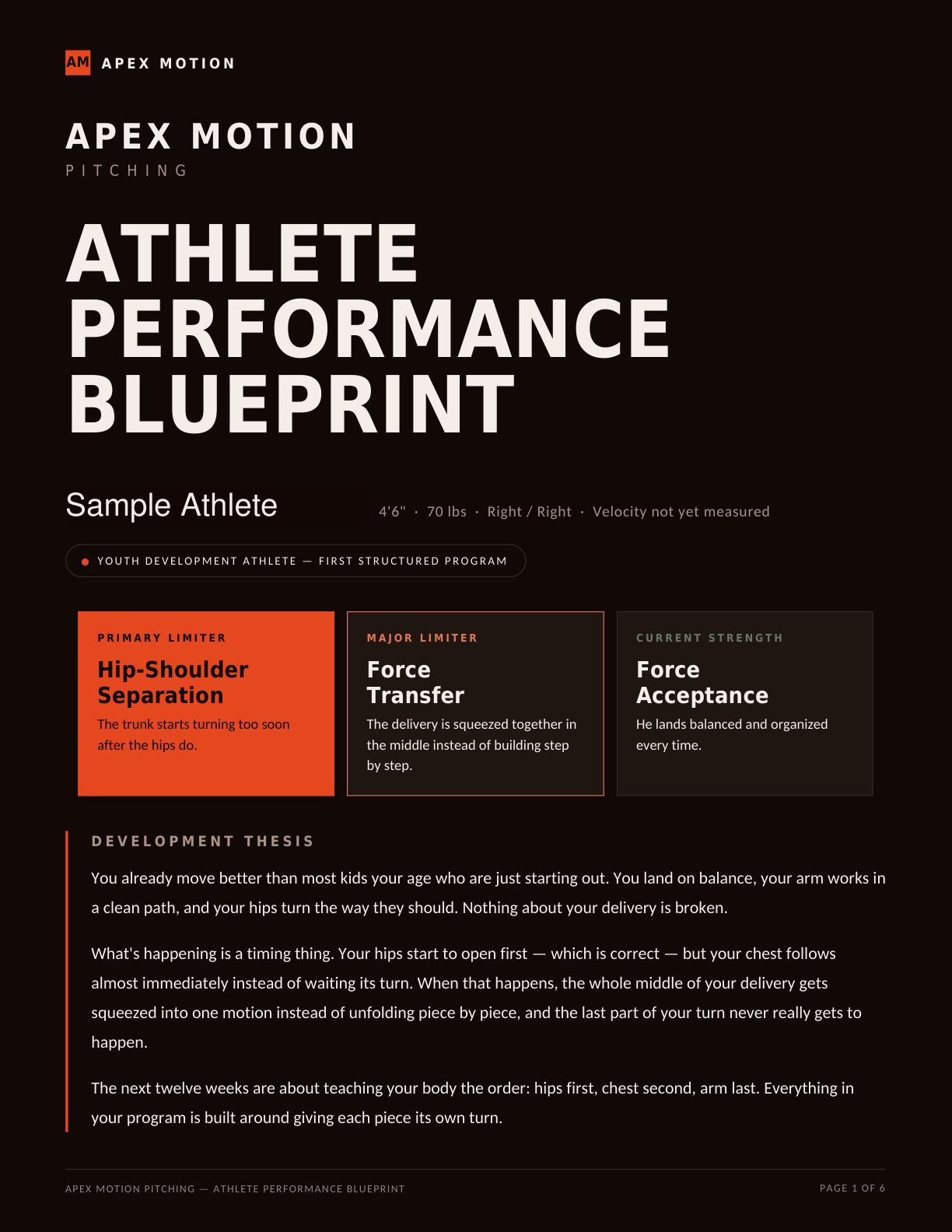
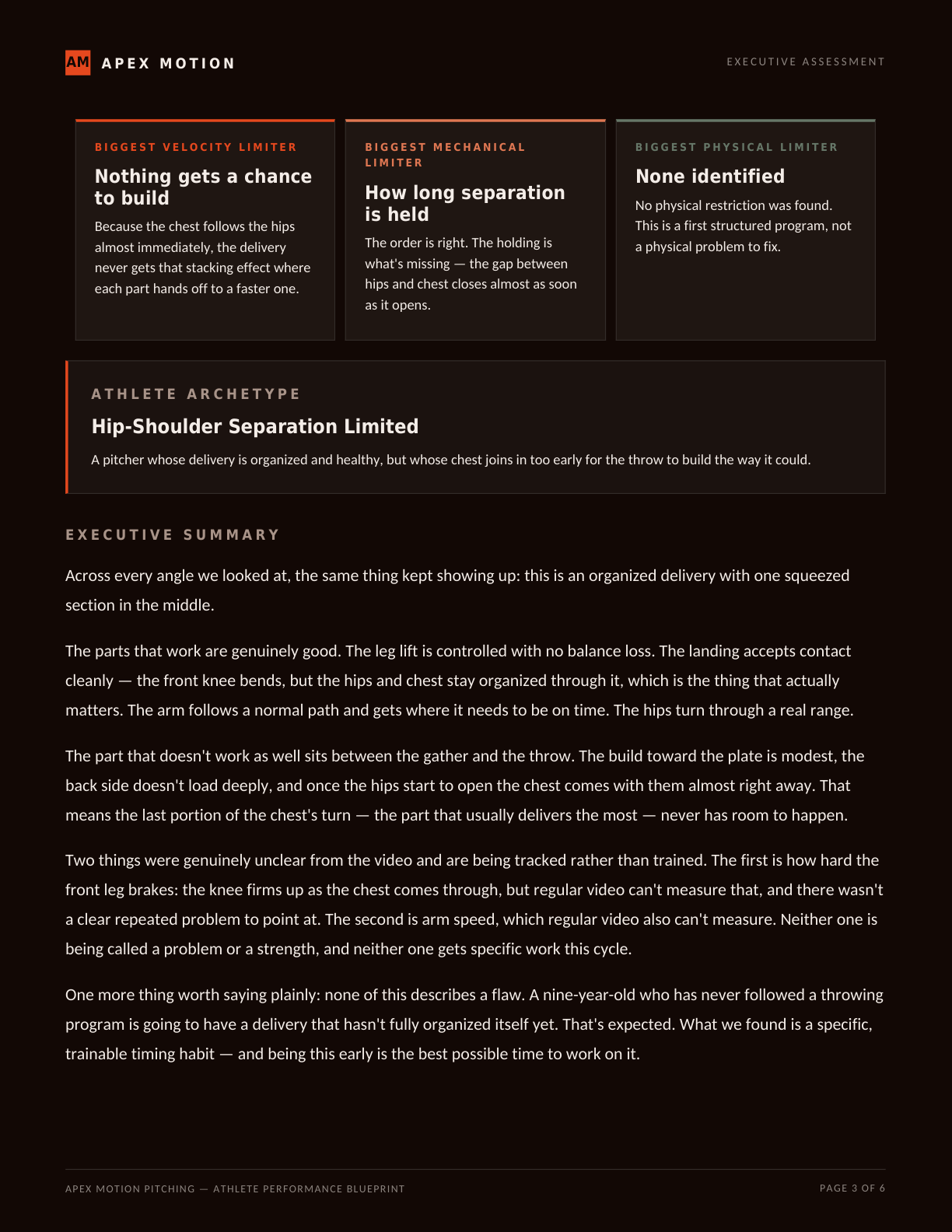
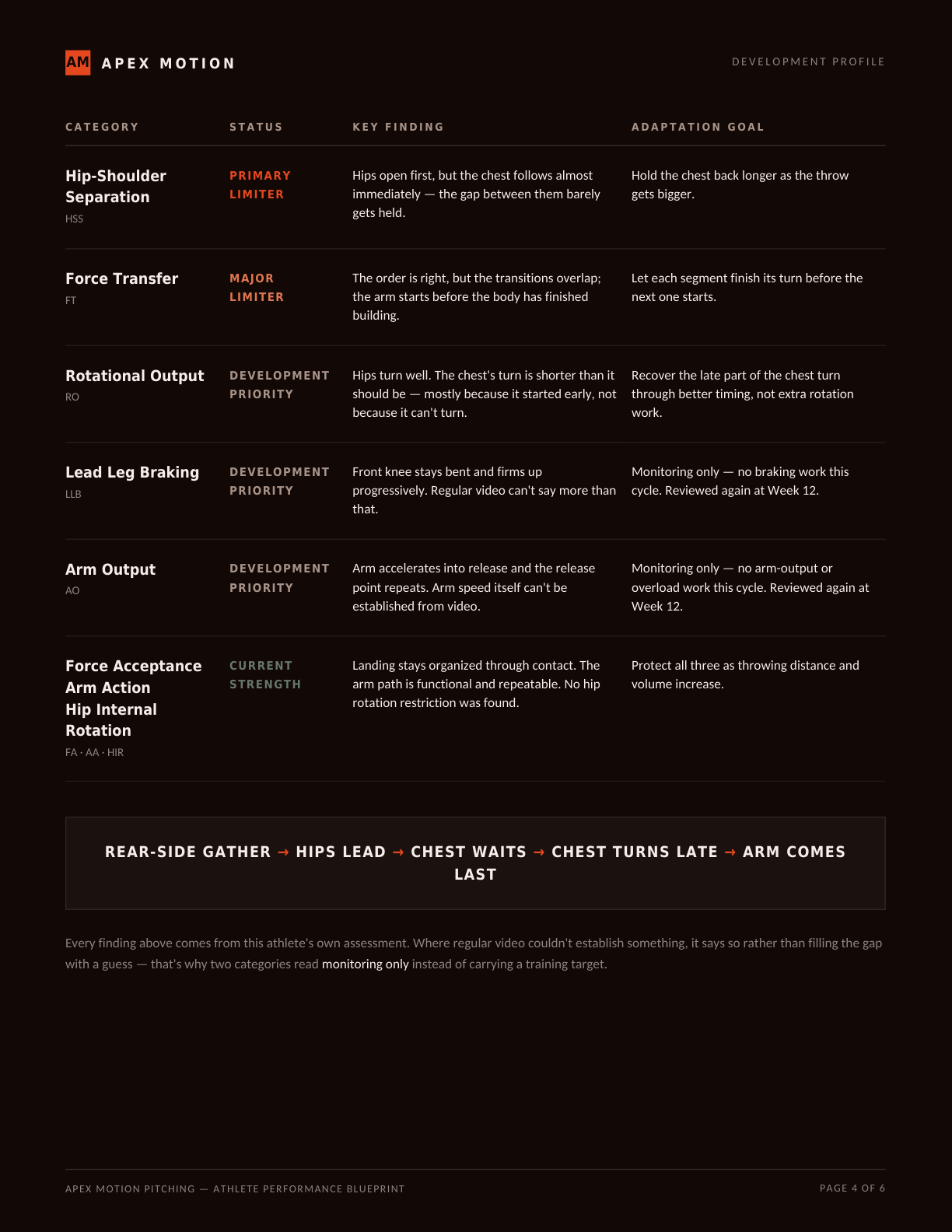
Cover 1 / 6
Every category is labelled for what it actually is on your delivery — primary limiter, major limiter, development priority, or current strength. Strengths get named too, not just problems.
Findings ordered by what matters most for you, each one carried directly into the interventions that show up in your app.
Strength, power, elasticity and rotational potential are reported as tested or untested. As the report itself puts it — untested is not the same as weak.
Sample report shown is built from a demo athlete profile. Generated under the same locked assessment prompt and governance configuration used for real athletes.
Apex Motion doesn't hand every pitcher the same drill list — and nothing gets invented for you either. Every option in your plan already exists in an audited library. Your findings and your constraints decide which ones you actually get.
What the assessment could actually establish from your video, mobility screen and intake — not what it guessed.
The adaptation that finding calls for, stated as a goal rather than a drill name.
Options from the primary library that serve that objective in your assessment category.
Training history, equipment, schedule, throwing status and any restrictions narrow that set.
Warm-up, strength, power, sprint work, conditioning, mobility and arm care — what a complete program needs around your development priorities.
Sequenced by phase and progression level — foundation before advanced, not everything at once.
Laid out day by day, with each piece traceable back to the finding or need that put it there.
Two complementary libraries with different jobs — one connects findings to matched interventions, the other builds the rest of a real program around them.
Covering throwing, strength, plyometric and medicine-ball work, mobility, corrective work, warm-up and movement prep, sprint and deceleration, conditioning, grip and forearm health, and arm care — plus progressions and equipment substitutions where an athlete needs them. Counts are audited, with duplicates between the two libraries removed.
Every recommendation should be traceable to a finding, constraint, or programming need. How the two libraries work together →
We ran Apex blind against real 3D motion-capture benchmarks, documented where it failed, rebuilt it, froze the final system, and tested it again.
Every assessment was produced from video and intake alone, locked to a non-editable record before the benchmark data was opened, and scored against rules written down in advance — then never revised, including when it turned out to be wrong. There is no single Apex accuracy percentage, and we don't publish one.
Every assessment maps your motion against the same locked framework — the same categories that structure your Blueprint report and your training plan, so nothing gets lost in translation between assessment and program.
Whether your chest waits its turn after the hips start to open, instead of following immediately.
Categories organize Apex Motion's assessment and programming framework. Video-based findings are observational and confidence-bounded — they are not direct laboratory measurements of joint kinetics, forces, or tissue loading.
Apex is built to turn a complex assessment into clear priorities and training a pitcher can actually use.
“It’s unbelievable. That’s a shit ton of really good info.”
After reviewing his assessment and program, Sawyer highlighted the linked exercise videos, the in-season day structure, and how much useful information was packed into the final product.
Evan liked the assessment and felt the summary and prescribed lifting lined up closely with what he had previously received in professional development. He described the overall product as really cool.
“The PDF pages look really good.”
He felt the assessment tracked closely with previous biomechanics feedback and coaching, and liked how the Ranked Development Priorities kept the information detailed without making it difficult to follow.
“It’s much cleaner to read than a traditional mocap report.”
He felt the major mechanical issues were addressed clearly without needing specialized biomechanics terminology to understand the report.
Early testing feedback reflects individual experiences and does not guarantee outcomes.
Start getting your videos and data ready before you commit — you'll move straight into your assessment the moment you sign up.
See What You Need