Apex Motion exists because the gap between finding out what's limiting a pitcher and actually doing something about it was where most of the value was being lost.
Apex Motion was built by people who have been through the training side of this sport, not by a software team that picked baseball as a market.
This section will carry verified founder background: playing and coaching history, training and performance credentials, and the specific experience that led to Apex Motion being built this way.
Deliberately left empty rather than filled with placeholder claims.
None of these are bad products. They just each leave a different part of the job undone.
Video feedback sees something
A read, but no program. Someone watches your delivery and tells you what they see. Often genuinely useful — but you're left holding an opinion and no structured way to train against it.
Biomechanics testing measures something
Measurement, then a handoff. A biomechanics lab measures things video cannot. Then the report usually goes back to you or your coach to interpret and turn into training on your own.
Programming trains something
A program, but from what? You get a plan. What's frequently missing is a traceable reason why these drills, for your delivery — rather than a good template applied broadly.
Apex connects the assessment to what gets trained.
Apex Motion is not a replacement for any of these. We don't measure joint forces, and we don't claim to. What we built is the connection that kept going missing: a structured assessment whose findings carry directly into the training that follows.
Some pitchers need the full laboratory. Some need daily, hands-on coaching. Both can be incredibly valuable.
But getting useful direction shouldn’t always require travel, a long-term facility commitment, or thousands of dollars.
Apex was built as another way in — structured assessment, clear interpretation, prioritized development needs and individualized training built around the athlete.
$150–$1,000
Pitching biomechanics assessment
Across seven publicly listed U.S. pitching-biomechanics evaluation offerings in our current market sample, prices ranged from $150 to $1,000. The sample median was $400.
Current examples that add interpretation, programming or reassessment reach $1,500–$2,000.
Technology, athlete level, interpretation and deliverables vary by provider. This is a current public market sample, not a national average.
~$175–$1,000+ / mo
Structured development
Publicly listed development programs span a wide range depending on coaching frequency, facility access, technology and service level.
$1,050–$1,500 / mo
High-touch 1:1 examples
At the high-touch end of our current sample, programs with multiple individual pitching and strength sessions each week reach four figures per month.
These are not equivalent products. A biomechanics lab can measure things Apex cannot. A coach working with you multiple days each week provides hands-on services Apex does not. The comparison is about the range of access points available to an athlete — not claiming those services are interchangeable.
Examples of what a lab may measure or report
Kinematics Kinetics Joint angular velocity Kinetic-chain sequencing Pelvis / trunk rotation Joint angles
Those measurements can be powerful.
The athlete still needs answers to three simpler questions.
“It’s much cleaner to read than a traditional mocap report.”
He felt the major mechanical issues were addressed clearly without needing specialized biomechanics terminology to understand the report.
Assessment. Interpretation. Priorities. Programming.
Apex connects those pieces remotely, giving an athlete a structured place to start without requiring relocation or a full-time facility commitment.
Apex isn’t the lab. It isn’t your pitching coach. It’s the system built to help you understand what may be limiting you and turn that information into what you train next.
Publicly listed U.S. pricing reviewed September 2026. Prices and offerings can change. Providers differ substantially in technology, coaching access, athlete level, facility access, commitment length and included services. Figures shown are illustrative market examples, not a national average.
Apex does not claim these services are equivalent to one another or to Apex Motion. The sample is provided to show the range of access points and commitments available to baseball athletes.
These packages add interpretation, programming or reassessment, so they are kept separate from the seven evaluation-offering prices.
The ARMory remote programs are multi-month subscriptions. Their monthly figures are our calculated equivalents, not advertised month-to-month prices.
Higher-access developmentStandard listed prices. Lower promotional pricing was publicly listed when reviewed in September 2026.
Tread Athletics publicly states that athletes commit to 12 months of guidance, with a one-time assessment fee and annual or monthly payment options. A fixed public price is not listed, so Tread is intentionally excluded from the numerical price ranges.
Five stages, in one direction. Each one only uses what the stage before it could actually establish.
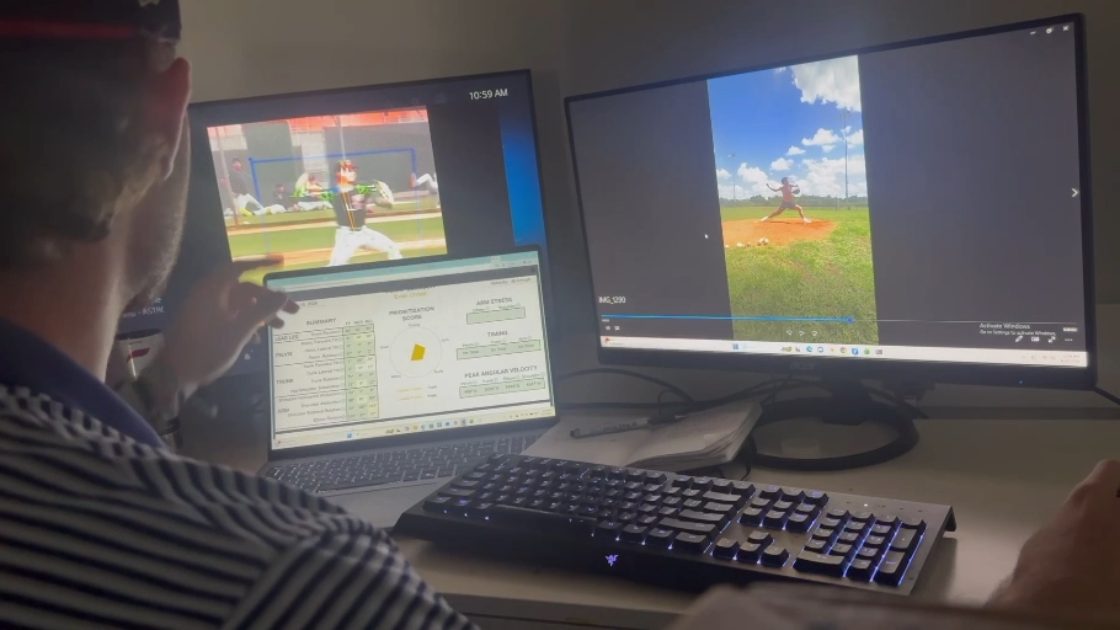
Multi-angle pitching video, a mobility screen, and athlete context — training history, throwing status, equipment, schedule and restrictions.
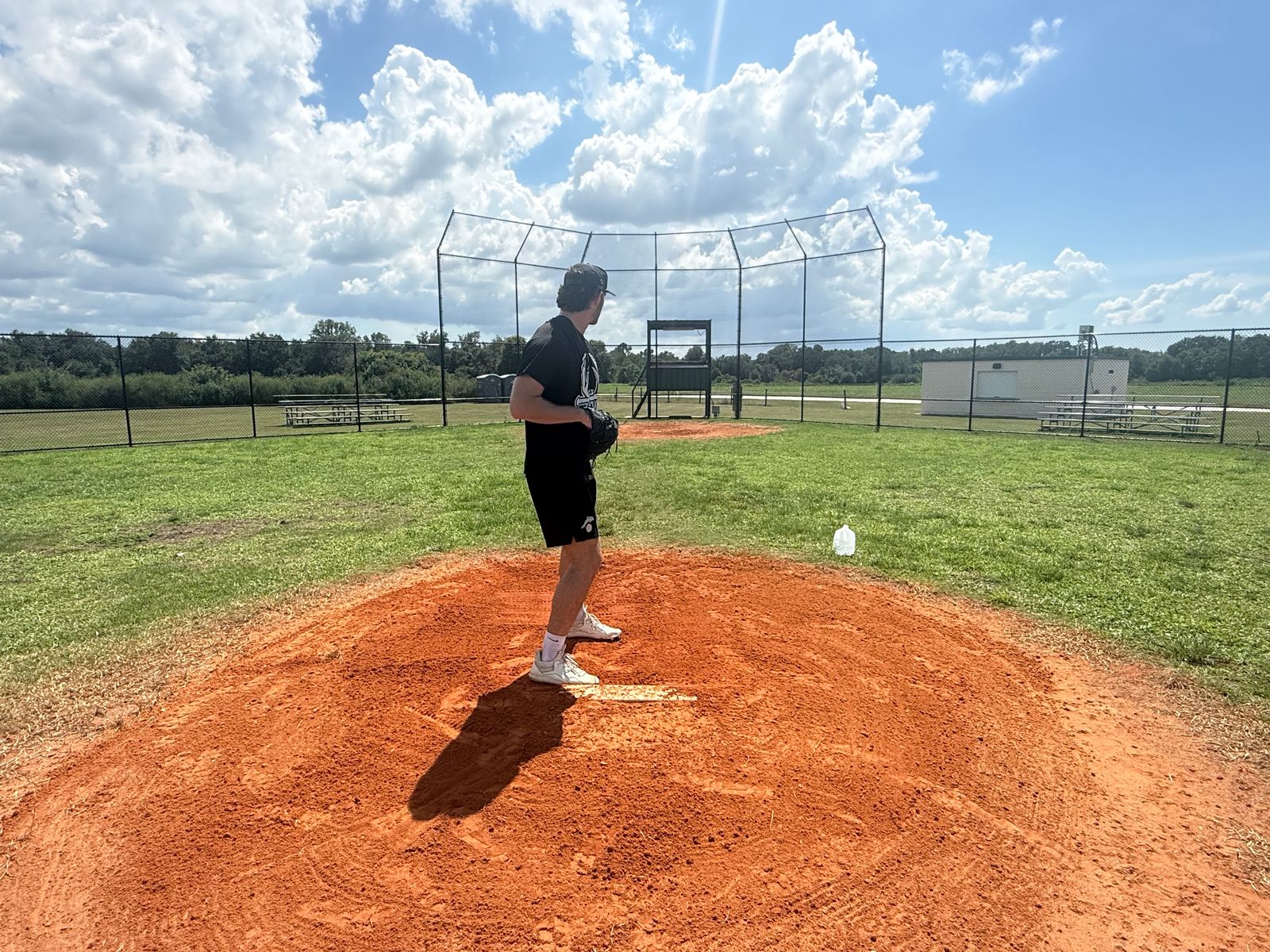
Your delivery is evaluated through the same 8-category pitching assessment framework used for every athlete, with confidence and evidence limits attached.
The Athlete Performance Blueprint is a readable report: what was found, how confident each finding is, and what couldn't be assessed from the evidence you sent — with findings ranked by what matters most for you, not eight equally-weighted observations.
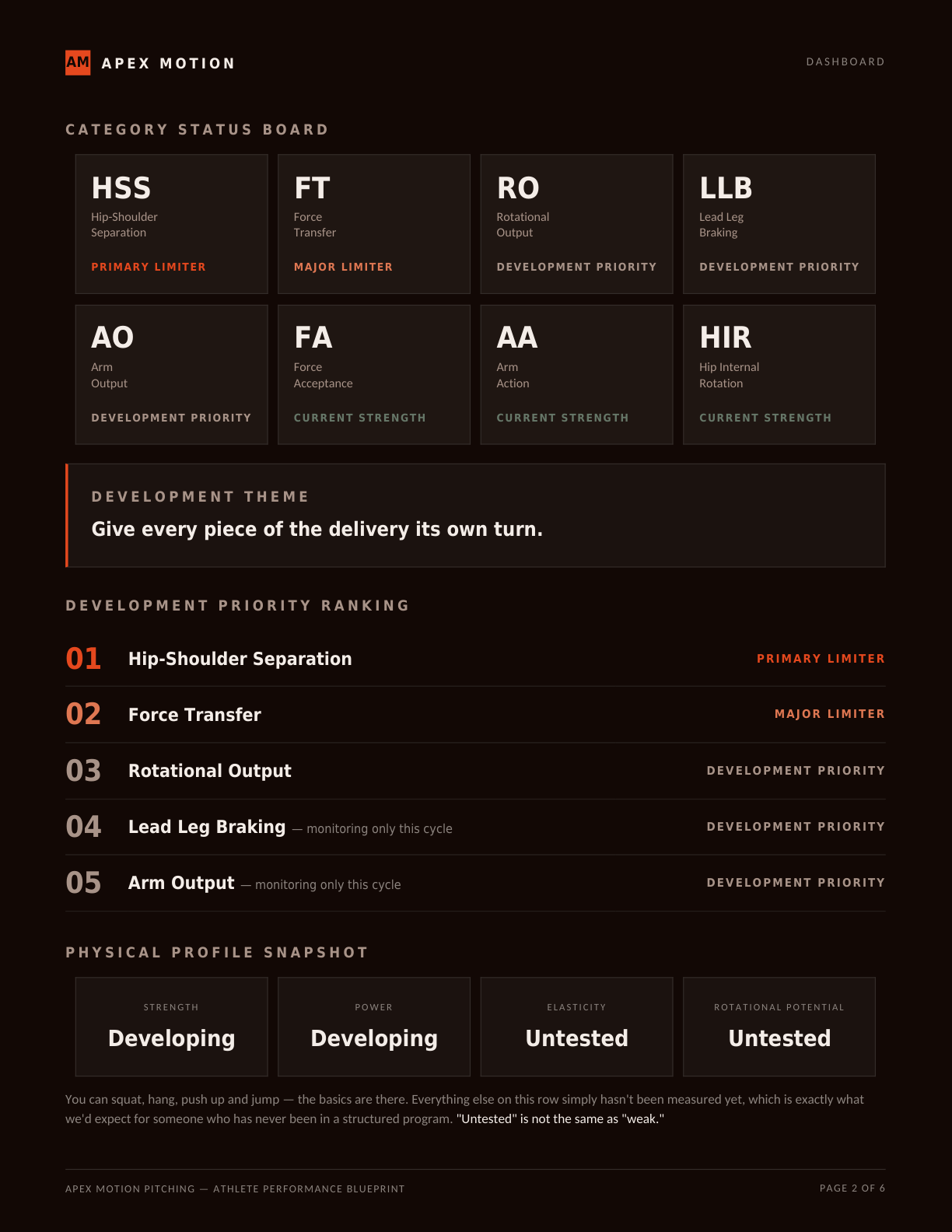
Each priority becomes a development objective.
Each objective narrows the finding-matched library against your own constraints — then supplemental programming fills out the rest of the week.
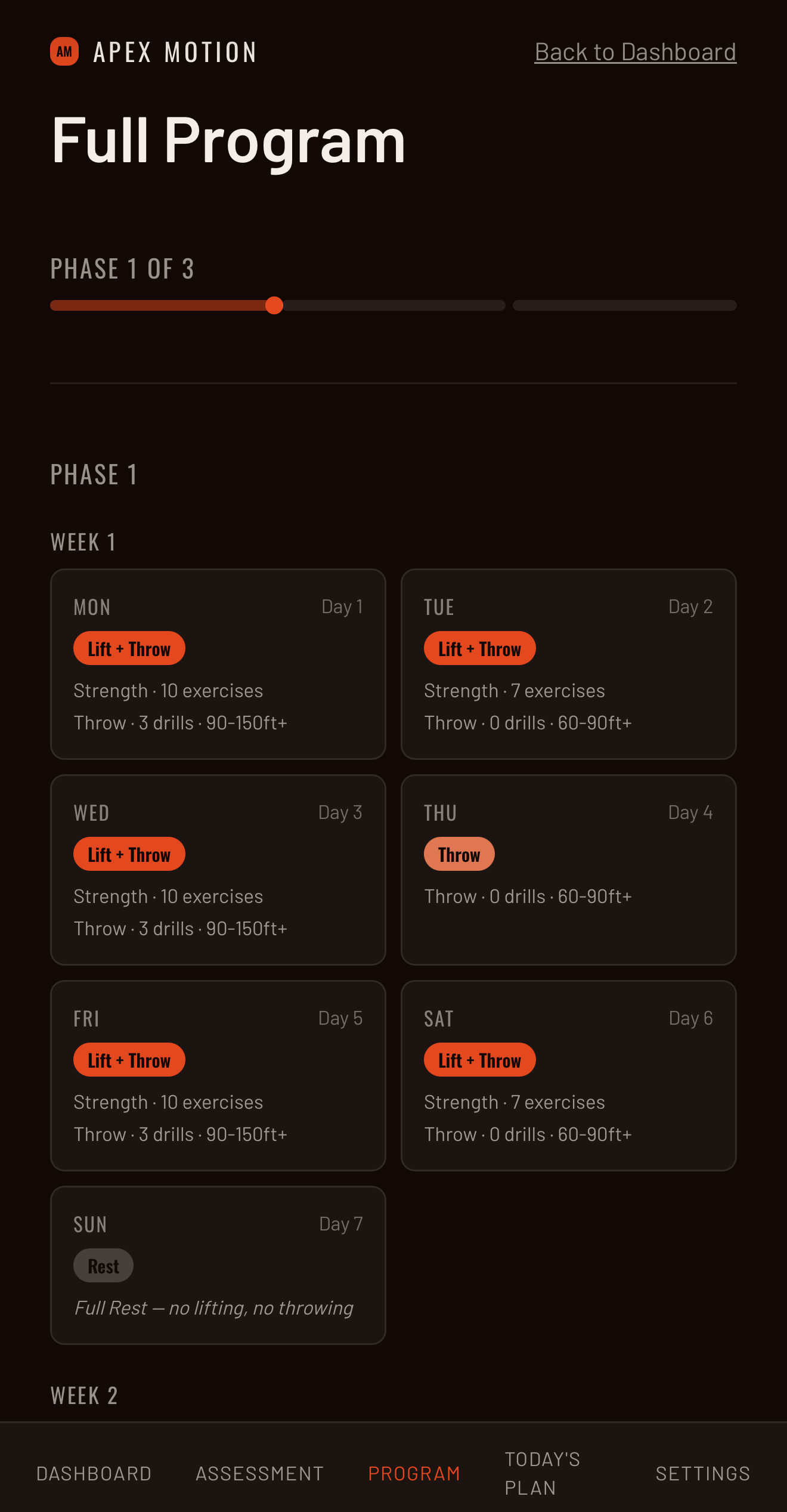
Sequenced by phase and progression level, delivered day by day — each piece traceable back to the finding that put it there.
The step-by-step decision chain is on the homepage. How the two libraries divide the work is below.
Knowing your top development priorities tells you what to work on. It doesn't tell you what the other four days of the week look like. Apex Motion runs two audited libraries because those are genuinely different problems.
Every entry is mapped to one of the eight assessment categories and carries its own adaptation goal, phase, progression level, transfer rating and cautions. This is the library that connects a supported finding to something you actually do about it.
Your development priorities decide what you work on. This library builds the rest of the week around them — the preparation, strength, capacity and health work that turns a set of priorities into a complete program you can actually run.
The two libraries share three entries by name; those are counted once, not twice. The combined figure includes distinct exercises, progressions, variations and equipment or load substitutions — because all of those are things an athlete can actually be given, and a plan that ignores equipment reality isn't individualized.
Cross-cut by workbook role — throwing prep, lift prep, power block, corrective work, warm-up, mound transfer and recovery.
Joint & tissue health includes arm care and shoulder health, grip and forearm work, and foot and ankle support.
Seventeen audited sections holding 222 entries in total. Three of them also appear in the primary library, so they are counted once rather than twice — leaving 219 unique to this bank.
Individually none of these are exotic. Together they're what separates a structured assessment system from a confident opinion.
You are not assessed against whatever stood out that day. The framework is fixed, so two athletes with the same limitation get the same category called the same way.
Where your footage can't support a finding, the category says so rather than producing a confident guess. Withholding is tracked as its own outcome, not hidden.
Whole classes of output — projected velocity, future ceilings, asserted root causes — are structurally blocked rather than discouraged.
Assessments were locked before independent biomechanics reports were opened, then scored against them — and never revised afterwards, including when they were wrong.
Both halves matter. One makes your assessment better; the other is what makes our benchmark honest.
Everything described on this page is visible somewhere else on the site, in its actual form.
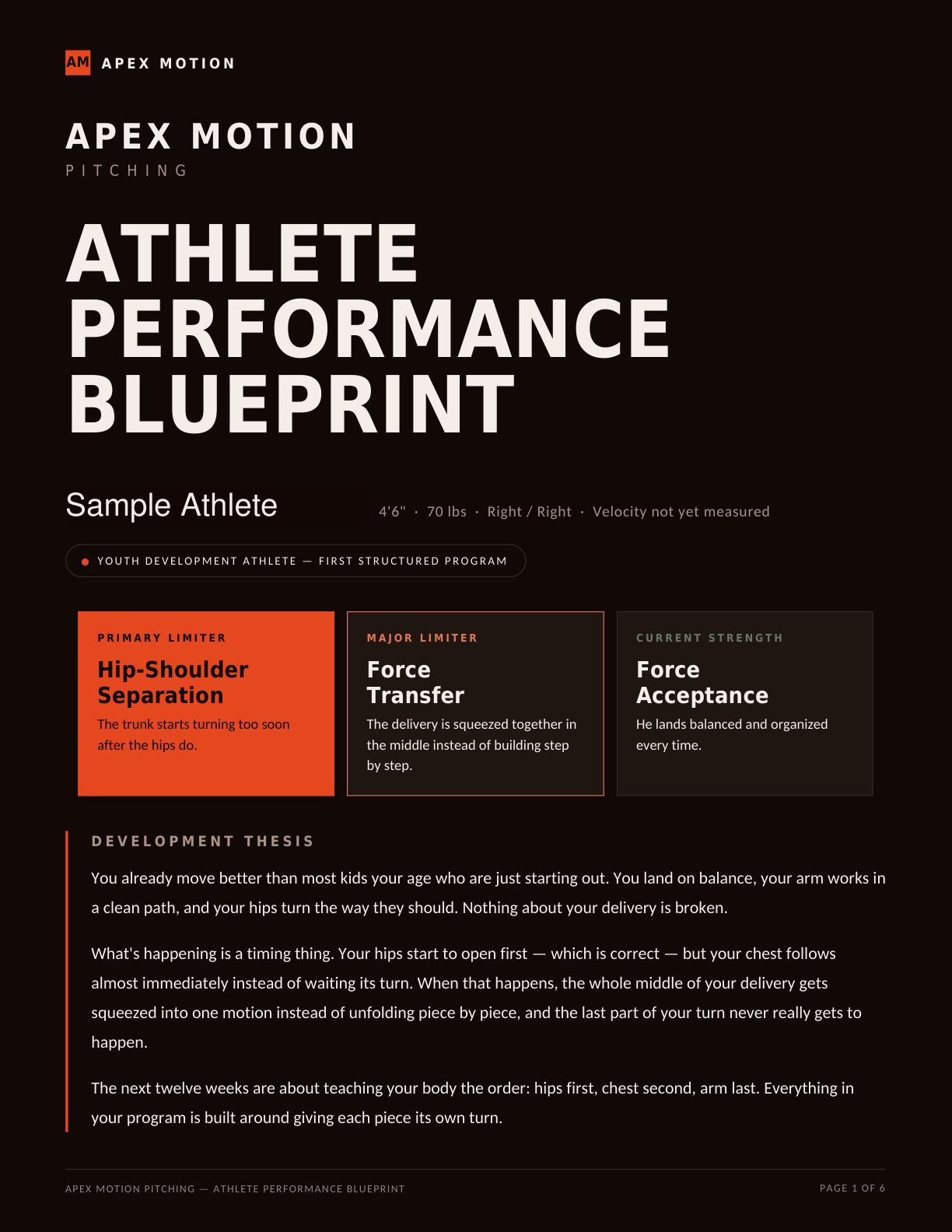 The report
A real Athlete Performance Blueprint
The full six-page sample, generated under the same locked configuration used for real athletes.
Open the sample →
The report
A real Athlete Performance Blueprint
The full six-page sample, generated under the same locked configuration used for real athletes.
Open the sample →
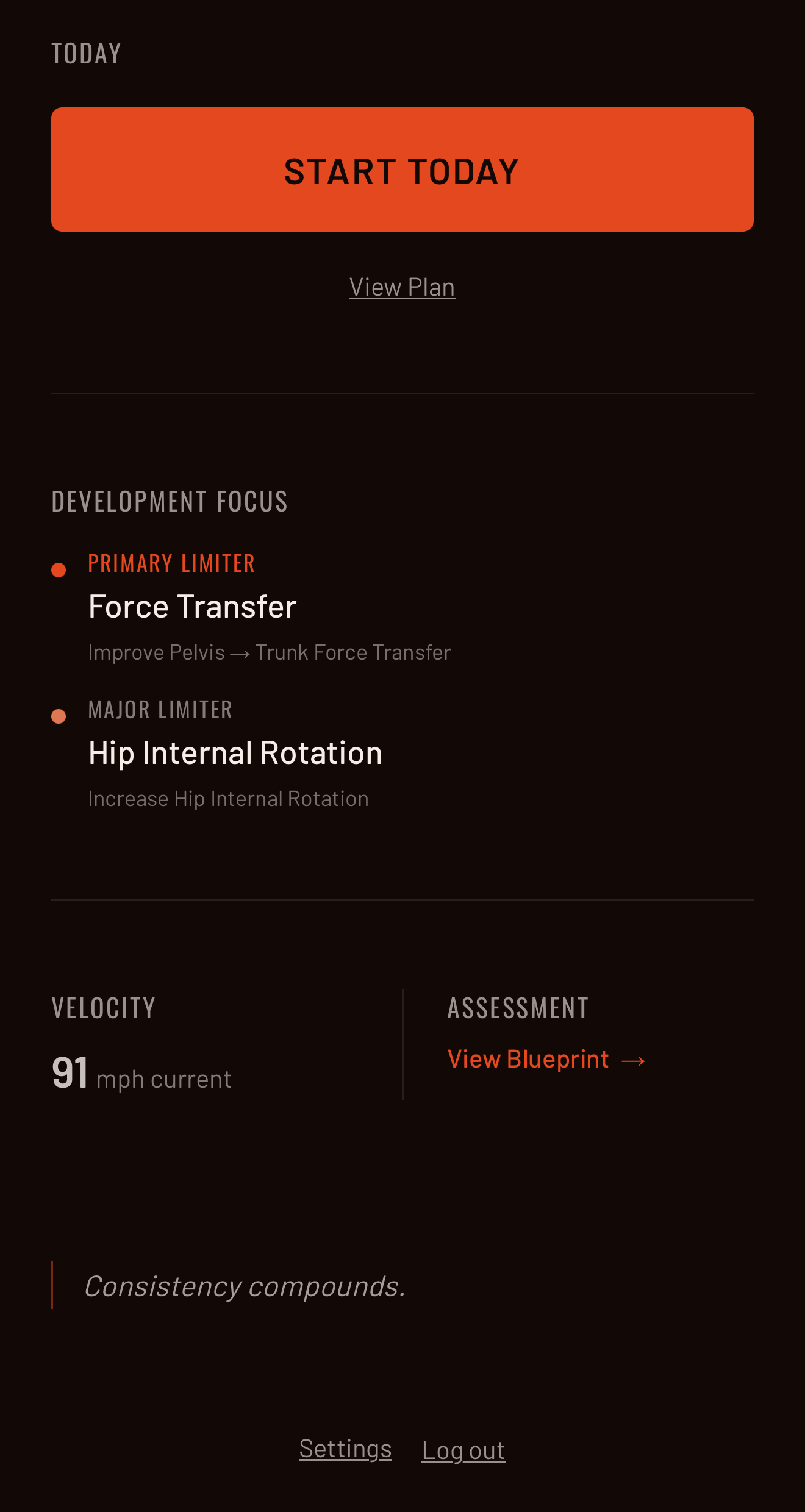 The training
The app you'd actually use
Real screens from the Apex Motion app — dashboard, development focus, full program and today's session.
See the app →
The training
The app you'd actually use
Real screens from the Apex Motion app — dashboard, development focus, full program and today's session.
See the app →
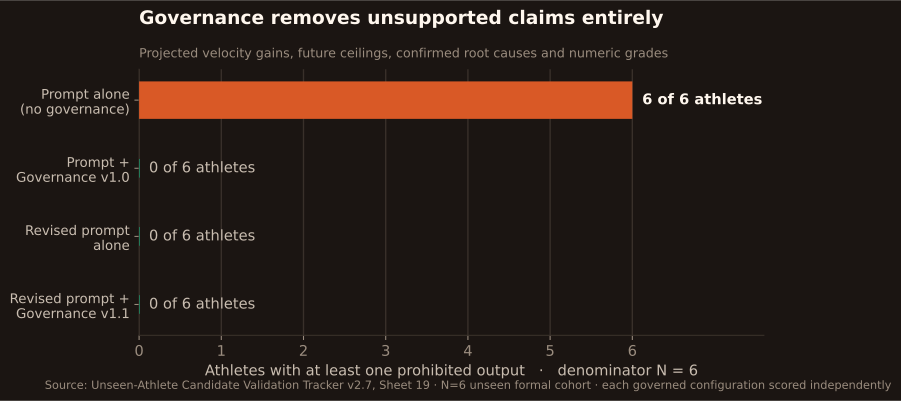 The testing
How the system was benchmarked
Blind comparison against independent biomechanics reports, with the documented failures published alongside the results.
Read the validation →
The athletes
“The PDF pages look really good.”
Corbin Barker · Professional Pitcher
He felt the assessment tracked closely with previous biomechanics feedback and coaching, and liked how the Ranked Development Priorities kept the information detailed without making it difficult to follow.
Early testing feedback reflects individual experiences and does not guarantee outcomes.
Read the feedback →
The testing
How the system was benchmarked
Blind comparison against independent biomechanics reports, with the documented failures published alongside the results.
Read the validation →
The athletes
“The PDF pages look really good.”
Corbin Barker · Professional Pitcher
He felt the assessment tracked closely with previous biomechanics feedback and coaching, and liked how the Ranked Development Priorities kept the information detailed without making it difficult to follow.
Early testing feedback reflects individual experiences and does not guarantee outcomes.
Read the feedback →
Start with the assessment. If you'd rather get your video and information ready first, that page walks you through exactly what to send.