Apex makes the call first. Then we open the lab report.
That order is the test. Reverse it and the result means nothing.
Apex Motion's assessment was developed by comparing what it found
against independent 3D motion-capture and biomechanics
reports it was never allowed to see first.
Every run on this page was produced from video and intake alone,
locked to a non-editable record, and only then scored.
Side by Side
What Apex called. What the benchmark said.
Three representative cases, anonymised: one clean agreement, one
outright failure and the recovery that followed it on the frozen
system, and one deliberate withholding.
Lead leg braking
Apex called
Lead leg braking flagged as a primary limiter, from video and intake alone.
→
Benchmark found
The independent biomechanics report identified a lead-leg braking deficit of its own accord.
→
ResultAgreement
Recovered and held on the frozen production baseline.
Rotational output
Apex called
A large, visually dramatic torso rotation read as fast rotational output.
→
Benchmark found
Measured rotational output was among that athlete's weakest features — the opposite direction.
→
ResultWrong direction
Pre-revision system. This failure is what triggered the rebuild.
After the rebuild — frozen system
Apex called
On the frozen system, the two athletes whose rotation had been read backwards now return “not assessable”.
→
Benchmark found
Same benchmark reports, re-scored against the same pre-written rules.
→
ResultRecovered
Neither control regressed in the frozen confirmation suite.
Rotational velocity
Apex called
No rotational-velocity call made. Video cannot establish segment velocity, so the claim is blocked rather than estimated.
→
Benchmark found
The report contains a directly measured value.
→
ResultWithheld
Scored as its own outcome — never quietly counted as a correct answer.
Athletes are not identified, and no third-party report is reproduced.
These are the comparison outcomes as they were recorded in the scoring
ledger.
“If Apex got it wrong, the wrong answer stays on the record.”
Every miss on this page is an output we left exactly as it was generated
What the testing produced
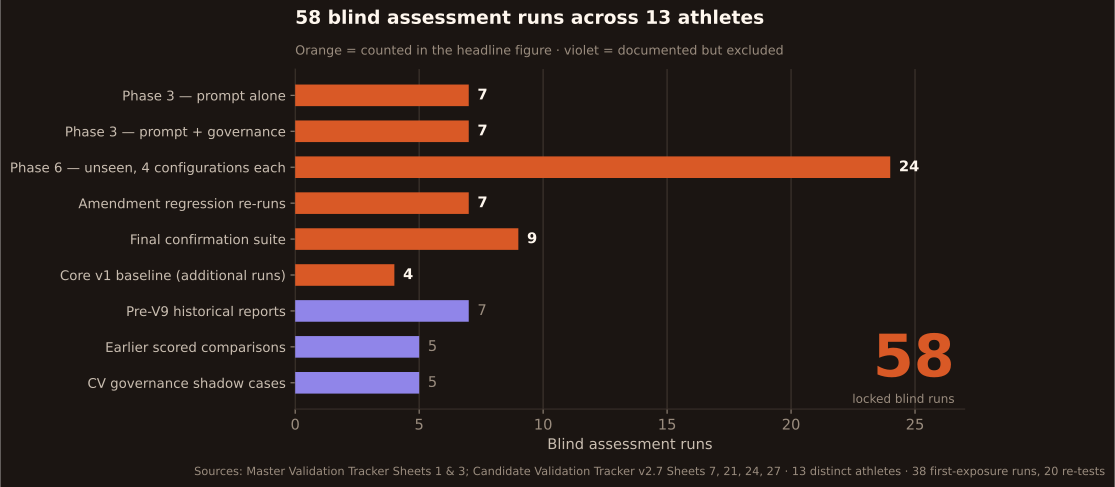
58Blind assessment runsAcross 13 distinct athletes. Findings were generated before benchmark comparison.
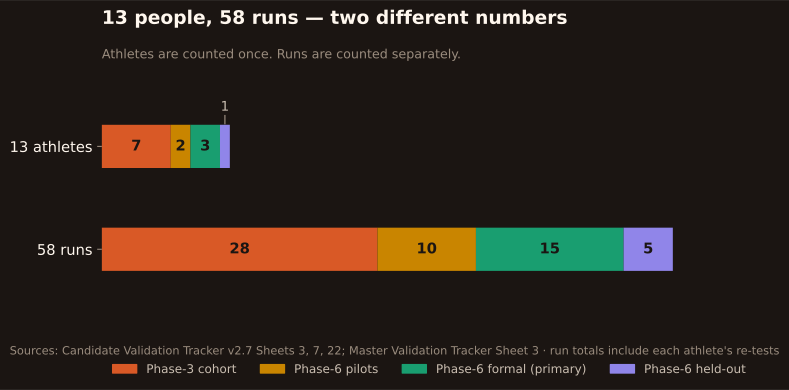
13Distinct athletesHigh school through affiliated professional baseball, including first-exposure runs and controlled re-tests.
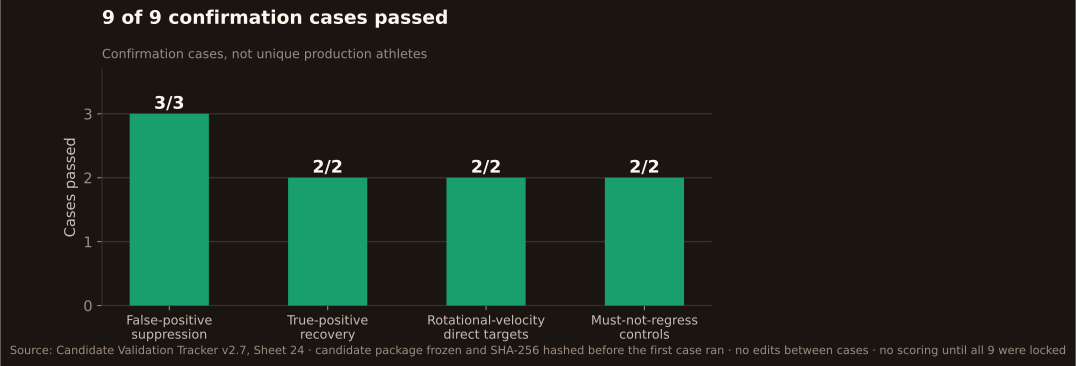
9/9Final confirmation cases passedConfirmation cases, not nine unique production athletes.
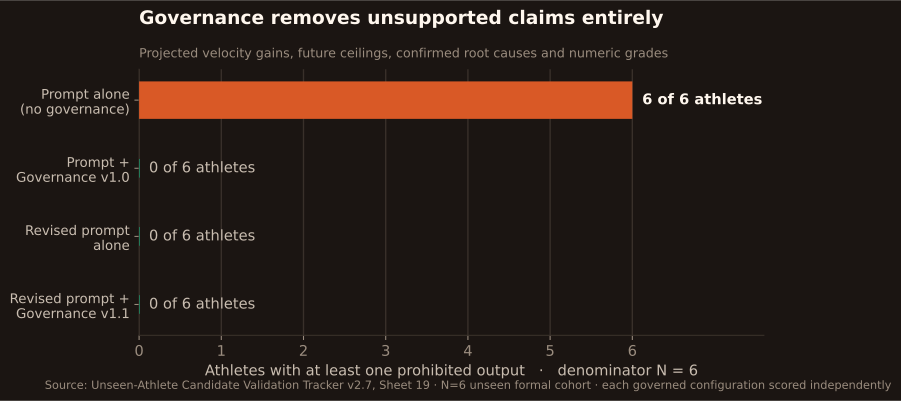
6/6 → 0/6Unsupported claims, without governance vs. with governanceN = 6 unseen athletes; each governed configuration scored independently.
Four different kinds of proof: scale and method, cohort, mechanism, and
verification. Each carries its own denominator, and the denominators are
never swapped.
There isn't one honest blended accuracy number — so we show the
comparisons that actually matter instead, and we do not publish a
global accuracy percentage.
The Benchmark
Why this benchmark matters.
Apex is benchmarked against independent 3D motion-capture and
biomechanics reports. Before the results mean anything, it's worth
knowing what that class of testing actually is.
What it is
3D motion capture is a laboratory biomechanics method used to analyse
movement in three dimensions. Multi-camera systems capture fast
athletic movement and allow researchers and high-performance
professionals to quantify movement that cannot be directly measured
from a single ordinary video angle.
Why it's the right bar
This class of technology is used in elite sport, biomechanics
research, high-performance training environments and professional
baseball. It runs on specialised multi-camera laboratory
infrastructure that most pitchers do not have routine access to —
which is exactly why it makes a demanding benchmark.
How a laboratory benchmark is produced — the independent benchmark
01
Multi-camera capture
Synchronised cameras record the same delivery from several angles at once.
02
3D reconstruction
Those views are combined into a three-dimensional model of the movement.
03
Biomechanical measurement
Joint angles and segment speeds are quantified — values a single video angle cannot produce.
04
Actionable report
The findings are written up as prioritised, actionable conclusions about the athlete.
So we hid that information from Apex.
Method
The order is the test.
Seven steps, always in this order. The order is the entire test — it
is what makes it impossible for the answer to have been influenced by
already knowing the answer.
Apex call
Made from video and intake alone. No access to the athlete's biomechanics report.
Answer locked
Saved to a non-editable, timestamped record. From this moment it cannot be changed.
Benchmark opened
Only now is the independent 3D motion-capture and biomechanics data revealed.
Comparison
Scored under rules written down before any athlete was opened. Agreements and misses weigh the same.
Failures retained
A locked assessment is never revised after the benchmark is opened — including when it was wrong.
Revisions
Narrow, line-by-line changes aimed at the named failures.
Frozen confirmation
Criteria written and frozen first, then the system tested against them.
How closely could a structured video-based assessment reproduce the
actionable findings contained in high-end biomechanics testing?
Governance
A system that knows when it isn't allowed to answer.
General-purpose AI tends to answer even when evidence is thin. Apex is
designed to withhold claims when the available evidence cannot
support them.
Without governance6/6produced at least one unsupported claim
→N = 6
With governance0/6produced an unsupported claim
Scope: N = 6 unseen athletes / independently scored
configurations. Each of the six produced at least one unsupported claim
with governance off; none did with governance on.
This is reliability engineering, not fine print. A system that never says
“I can't tell from this” isn't more accurate — it is guessing
more often and hiding it better.
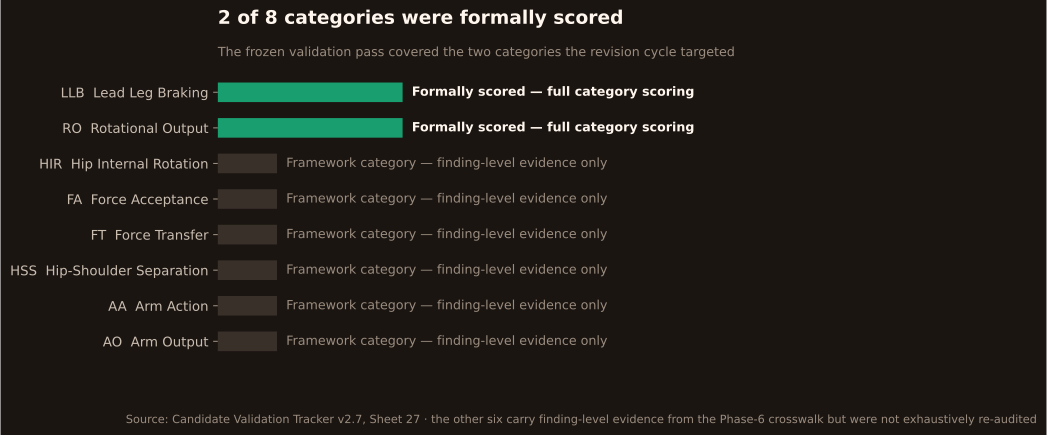
Scope: frozen production baseline · Lead Leg Braking +
Rotational Output · 2 of 8 formal categories · across
the 13-athlete baseline. This result does not describe the other six
categories.
Supported
Video-based assessment, benchmarked against 3D motion capture. 58 blind assessment runs across 13 distinct athletes.
Blind findings were locked before benchmark reveal — to a non-editable, timestamped record, 24 of them carrying a cryptographic file fingerprint.
Frozen formal scoring covers Lead Leg Braking and Rotational Output at category level, across the 13-athlete baseline: no misses, no false positives, no unsupported predictions.
Governance materially reduced unsupported output — from 6 of 6 unseen athletes to 0 of 6, N = 6.
The final confirmation suite passed 9 of 9 cases under a protocol frozen and hashed before the first case ran.
A documented failure, a documented fix, and a documented re-test — including the fixes that failed.
Limits
Where the evidence stops.
These are real constraints on what the evidence supports, not a
disclaimer block. If one of them matters to your decision, it should.
Scope of the evidence
The validation cohort contains 13 distinct athletes. The formal unseen cohort was N = 6. All rates are directional evidence, not statistically tight estimates.
Formal category-level scoring covers 2 of 8 categories. The other six carry finding-level evidence only.
Only one athlete was truly held out from earlier system-development exposure — and that case produced a miss.
Limits of the method
Video is observational, not laboratory measurement. Apex does not produce joint angles, segment velocities, hip-shoulder separation in degrees or projected velocity gains. Those are hard-blocked output categories, not features awaiting a release.
One global accuracy percentage is not methodologically supported. Rounds used different scoring methods and denominators; none may be averaged into a single figure, and we do not publish one.
“Not assessable” is an intentional outcome. When evidence is insufficient the system withholds — which sometimes means a real finding is not delivered.
The full limitation register — benchmark format heterogeneity, era gaps,
documentation gaps, procedural deviations and amendment failures — is
published in the technical details below. Nothing has been removed from
it; it is staged there because it is engineering detail rather than
buying information.
Traceability
Ask us where any number came from.
Every published validation figure traces to a named locked source record —
file, sheet and row. If you want to see the working, ask.
View Technical Validation Details
The full record: how a comparison runs, where the framework came from,
the cohort, every round's result — including the retired
pre-revision figures — the failures and fixes, the confirmation
protocol, category scope, human review, provenance and the complete
limitation register.
How a comparison actually runs
Five steps, in this order. The order is the entire test — it is what
makes it impossible for the answer to have been influenced by
already knowing the answer.
01 — Input
Video and context go in
Slow-motion pitching video plus the athlete's intake — strength numbers, mobility findings, injury history. Nothing from a lab.
What a coach can actually get.
02 — Apex call
Apex makes the call
The assessment is produced from that material alone. The session generating it has no access to the athlete's biomechanics report.
No peeking.
03 — Lock
The call is locked
Saved to a non-editable, timestamped record — 24 of them carrying a cryptographic file fingerprint. From this moment it cannot be changed.
The answer is sealed.
04 — Reveal
The benchmark is opened
Only now is the independent 3D motion-capture and biomechanics data revealed to the scoring session.
Now the benchmark opens.
05 — Score
Both are scored
Compared under scoring rules written down before any athlete was opened. Agreements and misses are recorded with equal weight.
Graded using rules that were already written.
FirstApex made its assessment from video and intake alone.
ThenThe findings were locked to a non-editable, timestamped record.
Only thenThe independent biomechanics benchmark was opened.
Where it came from — Apex didn't start with an empty prompt
The assessment framework was built on an existing body of knowledge
first, then tested against independent measurement — not
improvised and rationalised afterwards.
The evidence foundation
What informed the framework
The eight-category framework and the reasoning behind it were built
from an extensive evidence library spanning pitching biomechanics,
mechanics, physical preparation, movement and training —
drawing on peer-reviewed research, biomechanics literature, case
studies, expert educational material and applied
pitching-development resources.
Those source types do not carry equal authority, and we don't treat
them as if they do. Peer-reviewed biomechanics research and a
coaching video are both useful inputs to how the framework reasons;
neither one, on its own, licenses a claim about a specific athlete.
What an individual assessment is permitted to state is decided
separately — see below.
The governance layer
What Apex is allowed to claim
Governance is a different job from research. The evidence library
helps Apex reason about pitching in general. Governance decides what
Apex may actually say about you, given only the evidence
your own submission contains.
Research shapes how the system thinks about a delivery.
Governance gates what any single assessment may assert.
If your footage can't support a finding, the framework's general knowledge does not fill the gap — the category returns not assessable.
How the system got to production
01Evidence foundationExisting biomechanics, training and movement literature and applied resources.
02Assessment frameworkEight categories defined, with the reasoning structure behind each one.
03Early blind testingAssessments locked before independent benchmark reports were opened.
04Documented failuresSystemic error patterns named and recorded rather than smoothed over.
05Governance rulesWhole classes of unsupported output made structurally impossible.
06Targeted revisionsNarrow, line-by-line changes aimed at the named failures.
07Frozen confirmationCriteria written and frozen first, then the system tested against them.
08Production lockConfiguration locked 2026-08-14 with cryptographic hash verification.
The cohort — 13 athletes, 58 blind assessment runs
Athletes are counted once. Runs are counted separately. Those are
different numbers and we keep them apart.
13 distinct athletes
produced
58 blind assessment runs
38 first-exposure runs — the athlete's benchmark had never been compared before20 re-tests — regression, confirmation and baseline runs
A re-test is another run, not another person. Thirteen people produced
fifty-eight runs.
24 of the 58 carry a recorded cryptographic file fingerprint. A note on
wording: there are 58 runs and 57 benchmark comparisons
— one blind Core v1 run was produced but never compared, because
that athlete's benchmark was not supplied in the scoring session. We
report runs.
How close did Apex get to the benchmark? — round by round
There isn't one honest blended accuracy number — so we show the
comparisons that actually matter instead. Different rounds tested
different scopes, categories and scoring rules; averaging them would
produce a figure that sounds precise and means nothing. What follows
is the progression as it was recorded, strongest evidence first.
01Where we started
The first properly controlled test.
Seven athletes went through the system twice — once with the safety
layer, once without — with the benchmark data sealed until both
were locked. It was scored at the strictest possible standard,
where only an exact category match counts and “close”
scores zero.
Real signal, well short of good enough. That result is what
triggered the rebuild.
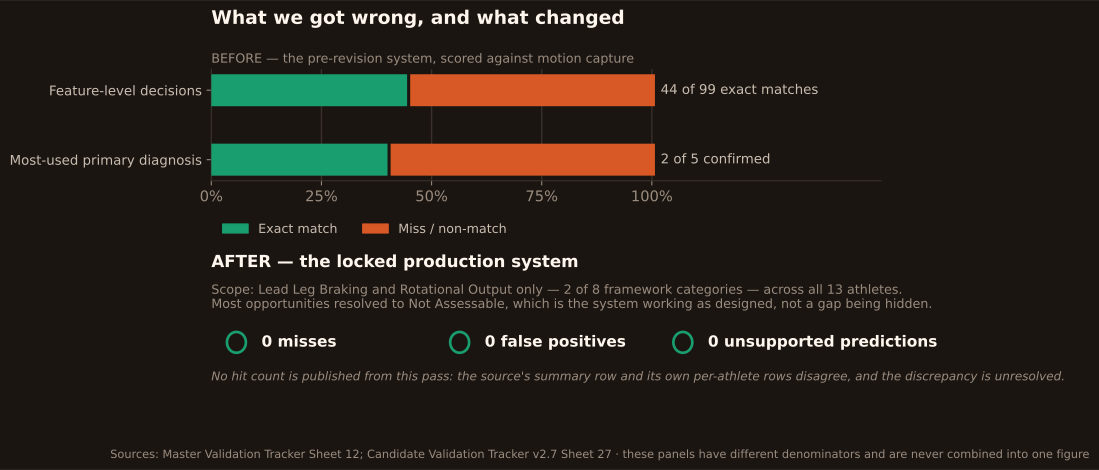
Pre-revision system — retired44 / 99Exact feature-level matches, pre-revision system · 7-athlete controlled retest · 99 scoreable feature-level decisions. Not current Apex performance.
02What broke
The pattern was worse than the average.
The most-used primary archetype was confirmed by the benchmark in
only 2 of 5 cases. And a specific optical illusion kept repeating:
a large, visually dramatic torso rotation was read as
fast rotation, when the measurement showed it was one of
that athlete's worst features. Every configuration willing to state
a direction got it backwards.
A confident, specific, wrong answer is worse than no answer. That
is the failure mode the rebuild was aimed at.
Pre-revision system — retired2 / 5Most-used primary archetype, confirmed by the benchmark · pre-revision system · 5 tested instances. Not current Apex performance.
03What we rebuilt
Three classes of failure, closed at the source.
Amplitude read as velocity. Rotational output can no longer be inferred from how dramatic a rotation looks. Where direction cannot be established from video, the system returns “not assessable”.
Over-selection of a favourite archetype. The primary finding that failed most often can no longer be selected on thin evidence.
Claims the evidence could not support. Projected velocity, future ceilings, numeric grades and asserted root causes became structurally impossible to emit rather than discouraged.
3Surgical revisions, each diffed line by line against the source files before the final freeze. Full amendment ledger — including the fixes that failed — is in the technical details.
04After the rebuild
What the frozen production baseline did.
The final configuration was locked with cryptographic hashes. All
13 athletes were then run through that exact configuration. On the
two movement categories the rebuild targeted — the ones with the
strongest benchmark detail — it recorded:
0Misses
0False positives
0Unsupported predictions
Scope: frozen production baseline · Lead Leg Braking +
Rotational Output · 2 of 8 formal categories · across
the 13-athlete baseline. This result does not describe the other six
categories.
Both lead-leg findings the benchmark had genuinely confirmed were
recovered. Both athletes whose rotation reading had been backwards
now return “not assessable” instead of a confident wrong
answer.
05The remaining gap
Where the evidence still stops.
Only one athlete was genuinely held out from earlier
system-development exposure — designated by a documented random
draw, using a recorded seed, before any athlete's identity, video or
benchmark data had been looked at. That athlete had a real lead-leg
braking limiter, ranked fourth in their own benchmark report's
development priorities. The governed system withheld rather than
calling it: correct by its own evidence rules, and still a finding
the athlete did not receive.
We publish this because a validation page without it isn't a
validation page.
Held out1Athlete truly held out from previous development exposure — and that case produced a miss.
Failure → fix → retest — we found the failures ourselves
None of this was discovered by a customer. Each of these is
documented in the same ledger as every result above.
Wrong-direction rotational read
Amplitude is not velocity.
Observed. A dramatic-looking torso rotation was read as fast rotation, in 3 of 4 scored athletes.
Cause identified. Visual amplitude was being treated as a proxy for a quantity video cannot measure.
Rebuilt. Rotational handling was reconstructed; direction can no longer be asserted from amplitude.
Retested. No recurrence in the confirmation suite, in either athlete who originally produced it.
Unsupported claim generation
Answers the evidence could not carry.
Observed. Without governance, 6 of 6 unseen athletes received at least one unsupported claim.
Cause identified. Nothing structurally prevented the system from producing predictions it could not support.
Rebuilt. A fixed, hashed governance layer was introduced, blocking whole classes of output.
Retested. 0 of 6 with governance, in each of three independently scored configurations.
Conservative withholding
The cost of not guessing.
Observed. The one truly held-out athlete had a real lead-leg limiter that was withheld rather than called.
Cause identified. The evidence threshold that blocks confident wrong answers also blocks some correct ones.
Recorded, not patched. Loosening the threshold to catch it would reopen the failure mode above.
Measured on both sides. Correct withholding and information lost to over-caution are logged in the same ledger.
Governance — what it blocks, why it holds, what it costs
The public result above is 6 of 6 → 0 of 6, N = 6. This is the
detail behind it.
What governance blocks
Projected velocity gains“This will add 1–2 mph” — a prediction dressed up as a measurement.
Future performance ceilingsA named mph range the athlete will reach by a named date. In one ungoverned run this was issued to a professional with a documented elbow reconstruction.
Unsupported numeric gradesA score out of ten that no camera can actually produce.
Asserted root causesA single named cause stated as fact when the video supports a hypothesis at best.
Why it holds
It is fixed. The same rules run for every athlete. There is no per-athlete tuning and no way to loosen a rule because a particular result would look better.
It is verified. The rule set carries a cryptographic hash. Any change requires a new version, a verified diff and a fresh confirmation suite.
It fails closed. When evidence is insufficient the system withholds. “Not assessable” is tracked as its own outcome, so it can never be quietly confused with a correct answer.
And what it costs
It withholds real findings too. In at least 4 of 7 early tests, governance withheld the single highest-value correct finding in the report.
In one case it introduced an error that the ungoverned read had avoided.
We do not oversimplify this. Our own record says it plainly: governance does not always help. Both sides are logged in the same ledger.
Confirmation — final system, frozen before the test
A pass rate is only as good as the protocol that produced it. The
protocol comes first here, because it is the reason the score counts.
Control 01
System frozen
The candidate prompt and governance rules were locked and cryptographically hashed before the first case ran.
Control 02
Pass criteria written first
Each of the nine cases had its success condition defined in advance, including which behaviours were not allowed to regress.
Control 03
No edits between cases
A failure in case 3 could not be patched before case 4. That is the difference between a test and a rehearsal.
Control 04
No scoring until all cases locked
Results were withheld until every case was complete, so no interim result could influence how a later one was read.
9 / 9Final confirmation cases passed
Confirmation cases, not nine unique production athletes.
These are re-tests of athletes already in the programme, using their
original blind inputs. We do not convert 9 of 9 into a percentage.
3 cases
False positives on the lead-leg finding are gone
2 cases
Genuinely correct lead-leg calls recovered, not destroyed
2 cases
The rotation-reading failure, targeted directly
2 cases
Controls that simply had to not get worse
All nine passed. Both target failure modes were fixed. Neither control
regressed. Zero prohibited outputs across all nine. It is confirmation
evidence — proof the fixes hold — not proof the system generalises to a
large new population.
Category scope — two of eight categories were formally scored
A category in the Apex framework is not the same thing as a category
included in a frozen scoring pass. We are not going to show you eight
scores when we formally scored two.
Formally category-scored in the frozen pass — 2 of 8Finding-level supporting evidence onlyNot formally category-scored
The other six categories are live parts of the assessment framework and
carry finding-level evidence. They did not receive frozen, category-level
scoring, so nothing on this page claims they did.
Human review — where people enter the process
Apex Motion is a governed system, not an unsupervised one. It matters
where the humans are — and just as much, where they are not.
Where human review applies
In the production workflow, when governance flags a serious or major issue on a real athlete's assessment.
Hands-on review of the athlete's own footage by people with athletic, baseball and movement backgrounds.
As an escalation and quality-control step, on cases the system itself has marked as needing another look.
In deciding whether a system change is warranted, through a documented revision and re-test cycle.
Where it does not
Not inside the blind benchmark workflow — a locked assessment is never revised after the benchmark is opened, including when it was wrong.
Not as a way to improve a benchmark result after seeing the answer.
Not to overrule an evidence boundary and turn a “not assessable” into a confident claim.
Not as silent editing — configuration changes require a new version, a verified diff and a re-run confirmation suite.
These are two separate workflows. The benchmark workflow exists to measure
the system honestly, so nothing in it may be revised after the comparison.
The production workflow exists to serve a real athlete well, so escalation
to human review is available there. Keeping them apart is what makes the
benchmark meaningful.
How to say it
Video-based assessment, benchmarked against 3D motion capture.
Benchmarked against independent 3D motion-capture and biomechanics reports.
Built to test how closely a structured video-based assessment could reproduce the actionable findings contained in high-end biomechanics testing.
“Not assessable” is a real answer. Where footage can't support a call, the category is marked Not Assessable rather than guessed at — and that outcome is scored separately, so it is never quietly counted as correct.
Provenance — where each published number comes from
Published number
Where it comes from
How it is calculated
58
Blind-Output Lock Registry and phase records
14 + 24 + 7 + 9 + 4 locked runs
13
Validation closeout, distinct-athlete count
7 + 2 + 4, with no double counting
6 of 6 → 0 of 6
Prohibited-output rate, unseen formal cohort
Athletes with at least one violation, out of 6
9 / 9
Final confirmation suite
Cases passed, out of 9 frozen cases
0 misses
Frozen production baseline
Per-athlete rows, Lead Leg Braking + Rotational Output
Retired44 of 99
Phase-3 pooled view, pre-revision system — superseded, not current performance
Exact matches, out of scoreable feature-level decisions
Retired2 of 5
Phase-3 archetype accuracy, pre-revision system — superseded, not current performance
Confirmed, out of tested instances
Production configuration locked 2026-08-14 with cryptographic hash
verification. Any future analytical change requires a new version, a
verified diff and a fresh confirmation suite before it can be
authorised.
The percentages we can publish, individually
Rows marked Retired describe the pre-revision system. They are published for traceability and do not describe current Apex performance. The frozen production baseline is the current result.
The frozen production system has no publishable percentage, and that
is a deliberate feature of the record rather than an omission. Its
scored pass produced counts, not a rate; the counts that reconcile
exactly are all zeros; and our own validation record prohibits
building a blended cross-round figure. A percentage here would be
manufactured, so there isn't one. Every publishable percentage below
describes the system we replaced.
Excludes the two athletes whose benchmark data is years older than their assessment · 78 scoreable feature-level decisions
47.5%
28 of 59
Same measure, clean-input subset
Excludes the two athletes with documented blind-test contamination exposure · 59 scoreable feature-level decisions
40%
2 of 5
Accuracy of the most frequently selected primary finding
Pre-revision system, the 5 athletes on whom that archetype was tested · 5 tested instances
25%
1 of 4
Same finding, ungoverned, on the next unseen cohort
4 resolvable athletes; 2 excluded because their benchmark format could not grade it · 4 resolvable athletes of 6
These are separate measurements with separate denominators. They are
never averaged together, and no cross-round global accuracy
percentage exists.
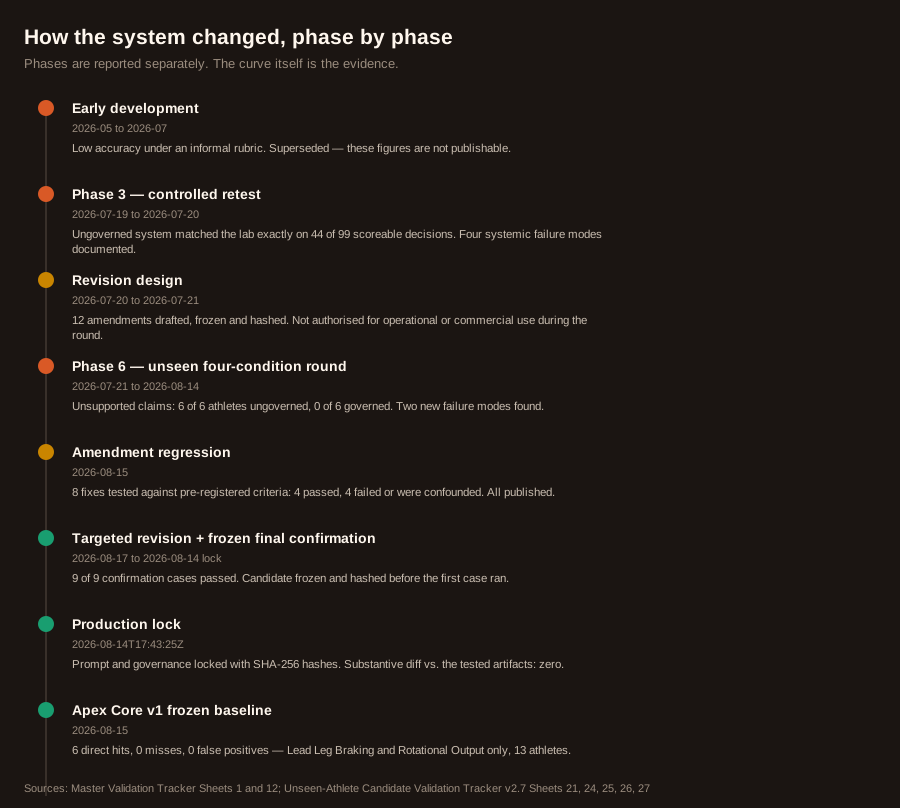
Development phases, reported separately
Phases are reported separately by design — each used its own scoring
method and denominator. The progression itself is the evidence;
blending it into one figure would destroy it.
2026-05 → 2026-07Early development
Low accuracy under an informal rubric. Superseded — these figures are not publishable.
Unsupported claims: 6 of 6 athletes ungoverned, 0 of 6 governed. Two new failure modes found.
2026-08-15Amendment regression
8 fixes tested against pre-registered criteria: 4 passed, 4 failed or were confounded. All published.
2026-08-17 → production lockTargeted revision + frozen final confirmation
9 of 9 confirmation cases passed. Candidate frozen and hashed before the first case ran.
2026-08-14T17:43:25ZProduction lock
Prompt and governance locked with SHA-256 hashes. Substantive diff vs. the tested artifacts: zero.
2026-08-15Apex Core v1 frozen baseline
6 direct hits, 0 misses, 0 false positives — Lead Leg Braking and Rotational Output only, across 13 athletes.
Documented misses, in full
Amplitude is not velocityA large, visually dramatic torso rotation was read as fast rotation; the measurement said it was one of the athlete's worst features. Every configuration willing to state a direction got it backwards, in 3 of 4 scored athletes. This is the failure the final revision was built to fix, and it did not recur in the confirmation suite.
A real limiter went unconveyedThe one held-out athlete had a genuine lead-leg braking limiter ranked fourth in their benchmark report. The locked system withheld rather than calling it. Separately, a hip-mobility limiter flagged as the single largest deviation in one report was underweighted or withheld by all four configurations tested.
A good composite can hide a bad featureA correctly-called above-average build-up composite contained a feature scoring 6 out of 100. A 32-degree trunk lateral-tilt outlier was surfaced by none of the four configurations.
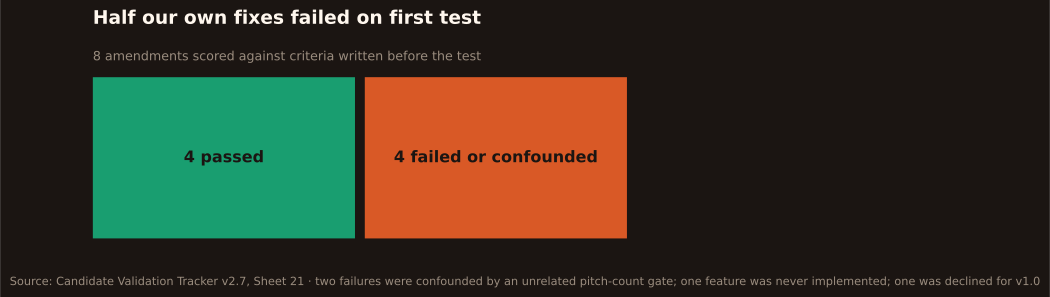
Half of our own fixes failed on first testOf eight proposed amendments, four passed and four failed or could not be cleanly tested. Two were confounded by an unrelated pitch-count gate; one feature turned out never to have been implemented at all; one was declined for production. All four are on the record as failures.
Full limitation register
Sample size13 distinct athletes; the formal unseen cohort was N = 6; one realised held-out athlete. All rates are directional evidence, not statistically tight estimates.
No overall accuracy figure existsScoring methods and denominators differ across rounds by design. The locked source states a cross-round global accuracy percentage “DOES NOT EXIST” and “must never be created”.
Category scopeThe frozen validation pass scored 2 of the 8 framework categories at full category level. The other 6 have finding-level evidence only.
Benchmark format heterogeneityGround truth came from several independent 3D motion-capture and biomechanics providers plus narrative laboratory reports, which differ in metrics, normalisation and whether population reference bands are printed at all.
Some benchmarks cannot grade a claimOne formal-cohort export carried no population reference bands, so above/below-average claims were logged Not Determinable rather than scored. One pilot athlete's benchmark images were cropped.
Era gapsOne athlete's benchmark predates their assessment by roughly five years. Another has two sessions six weeks apart with real test-retest variability.
Validation footage is not production footageLegacy validation footage is explicitly not representative of the standardised submissions production expects. Video quality was logged as methodological context and no locked result was re-weighted because of it.
Older intakes lack current fieldsOlder intake packets lack fields the current Master Intake Form captures — one documented miss (Hip Internal Rotation) traces directly to unstructured intake wording rather than to the assessment logic.
Documentation gapsSeveral historical and condition files lack input-hash manifests or precise UTC lock timestamps. Only 2 of 9 final confirmation reports self-document input hashes.
Procedural deviations, logged not curedThe two pilot athletes ran in fixed rather than randomised condition order, and were opened before any held-out subset was designated. Both were permanently excluded from the formal held-out subset rather than retroactively reclassified.
Amendment failures4 of 8 amendments failed or were confounded on first regression. Two were confounded by an unrelated pitch-count gate; one feature was never implemented; one was declined for v1.0. All four are published as failures.
Held-out subset was under-filledTwo held-out slots were designated; only one was filled, because the cohort closed at six athletes when eligible athletes with usable benchmark data ran out.
Video observation is not laboratory measurementApex reads observational evidence from video plus intake. It does not measure joint angles or segment velocities. Claims that require direct measurement — exact hip-shoulder separation in degrees, rotational velocity in deg/s, projected velocity gain — are categorically blocked, not estimated.
Computer vision is not production-approved for pitchingZero pitching CV measurements are production-approved. The most promising metric (throwing elbow flexion at ball release, mean absolute difference 5.44 deg) remains RESEARCH_ONLY for insufficient N and replication. Mobility CV is authorised only as a lower-authority supporting layer that cannot change or create a grade.
Source figures, as generated from the validation package
These are the charts produced directly from the locked validation
package. They are retained here unchanged so that every figure on
this page can be checked against its source rendering.
Cohort and run composition
Where the 58 comes from — and what we chose not to count.13 people, 58 runs. Two different numbers.
Results, governance and confirmation
Exact agreement, before and after. Two panels, two denominators, never combined.N = 6 unseen formal cohort. Each governed configuration was scored independently.Nine confirmation cases across four target groups, all passed.
Category coverage, amendments and phase progression
The frozen pass covered the two categories the rebuild targeted.Our own failure rate on our own fixes, tested against criteria written before the test.Eight phases, reported separately. Each used its own scoring method and denominator.
Want the assessment itself?
See the eight-category framework, the sample Blueprint, and what lands
in your app — then start when you're ready.